How do group appointments work for groomsmen and family?
News
The photographs are the reason this matters. Five men standing together, and either it reads as considered or it reads as five people who each bought something. Working out how to coordinate groomsmen outfits is not a styling problem so much as a people problem — because your best man is six foot two, your brother is not, one of them is twenty-six and another is fifty, and the answer that flatters one of them will not flatter all of them. The good news is that the solution is easier than matching, not harder.
The Short Answer
Do not dress them identically. Agree a direction instead — a tonal family and a shared texture — then let individual shirts vary inside it. Different builds and ages need different colours and fits to look their best, and a group that varies within a direction photographs as deliberate. A uniform photographs as a uniform.
Coordinating a group? Book a group appointment — everyone is measured and fitted in one session.
Key Takeaways
- Harmony over uniformity: similar tones, shared textures, thoughtful variation.
- Should groomsmen wear the same shirt — no, and it rarely flatters more than two of them.
- Fix the tonal family. Let colour depth, fit and weave vary by person.
- Older family members should sit in the same palette, not the same shirt.
- Settle who is paying before you brief anyone. It changes what you can ask for.
What Coordination Actually Means
Coordination is not sameness — it is a shared direction that different people can sit inside. The practical version has three layers, and only one of them should be fixed.
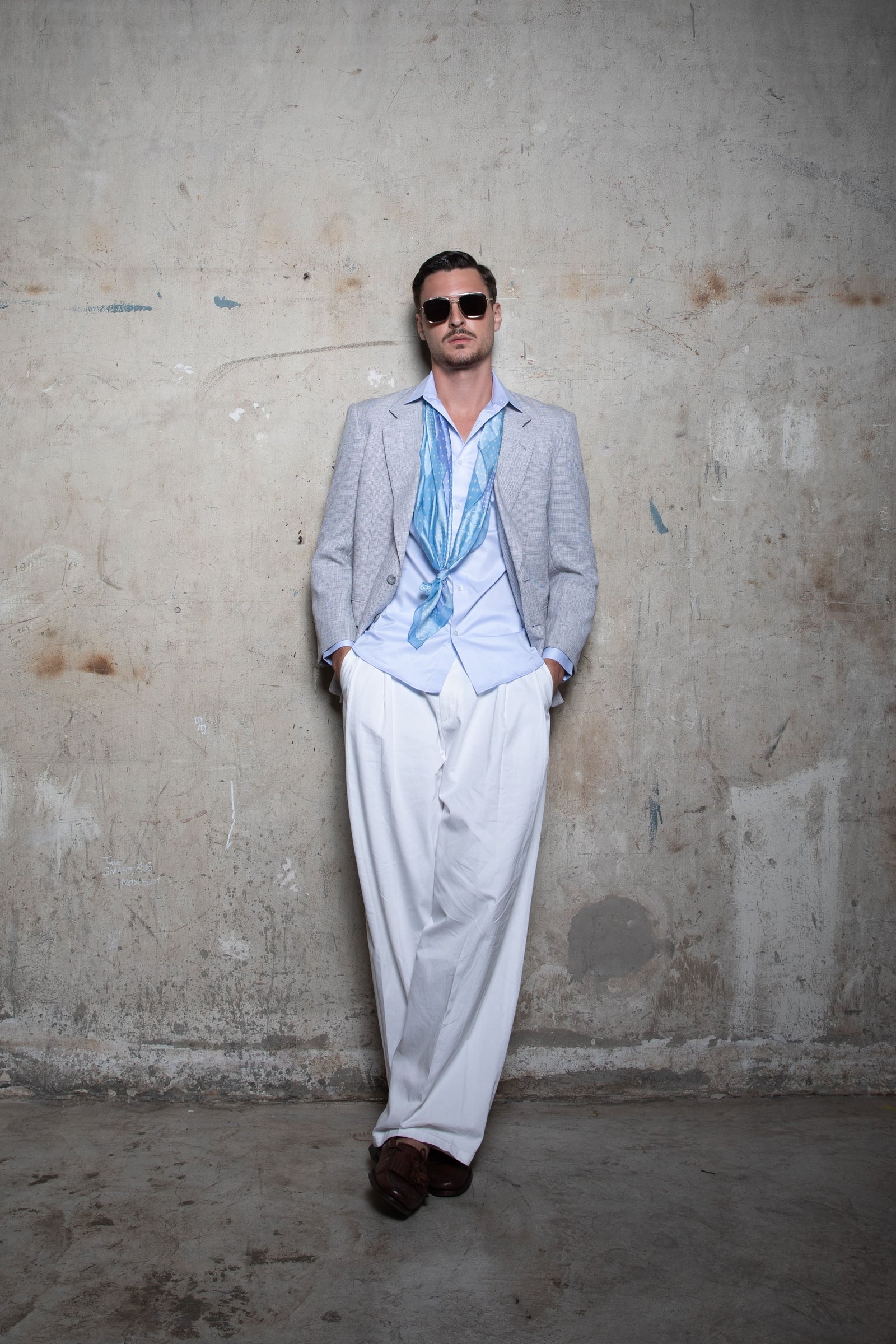
The layer you fix is the tonal family: a range rather than a single colour. Blues, or greys, or a warm neutral band. The layers you let vary are depth and texture — one man takes a deeper tone than another, one takes a fine weave where another takes something plainer. Do that and the group reads as a unit in a photograph while each man still looks like himself. Fix all three layers and you have a uniform, which is a different and generally worse outcome. This is why wedding party coordination works better as a brief than as an instruction: you are giving people a lane, not a costume.
Why Groups Are Being Dressed More Carefully Now
Wedding parties used to assemble themselves. Everyone wore something respectable they already owned, the photographs were what they were, and nobody thought about it much. That changed as Indian weddings became multi-day, heavily photographed events — because the moment a group is being photographed repeatedly across several functions, incoherence becomes visible in a way it never was in a single formal portrait.
What has not kept pace is the advice. Most content on what should groomsmen wear in India either assumes everyone is the same build or defaults to matching, which is the easiest answer and rarely the best one. Meanwhile the actual groups getting dressed are more varied than ever — friends, brothers, cousins and fathers spanning thirty years of age and every build there is. A matched set was never designed for that.
Dressing Groomsmen of Different Body Types
This is the part that decides whether coordination works, and it is worth being specific about it.
Fit should vary, not be negotiated
A man who needs room through the chest and shoulder should have it, and a man who does not should not be swimming in fabric for the sake of consistency. Fit is not part of the visual direction — nobody photographs a fit, they photograph whether a shirt sits correctly. Let each person have the fit that works and the group looks better, not worse.
Colour depth does more work than colour
How do you dress groomsmen of different body types comes down partly to tone: deeper tones read as more structured and tend to suit larger builds, while lighter tones sit better on slimmer frames. Keeping everyone in one family but varying the depth solves two problems at once.
Age wants variation, not exclusion
A fifty-year-old uncle in the same shirt as a twenty-six-year-old groomsman usually looks like he was assigned it. In the same palette, a quieter tone and a more conservative fit, he looks like part of the group and like himself.
What to Fix and What to Let Vary
| Element | Approach | Why |
|---|---|---|
| Tonal family | Fix it | This is what makes the group read as a group |
| Colour depth | Let it vary | Suits different builds and colouring |
| Texture or weave | Let it vary lightly | Adds depth without breaking the direction |
| Fit | Always individual | A badly fitting shirt undoes any coordination |
| The groom's shirt | Slightly apart | Same family, one step distinct |
Questions Grooms Ask About the Group
How do group appointments work for groomsmen and family?
How do group appointments work for groomsmen and family — you book one session and bring whoever is being dressed. There is no fixed minimum, everyone is measured and fitted individually within the session, and Made to Measure is available for anyone whose proportions need it without being imposed on the group.
Who pays for groomsmen shirts in India?
There is no fixed convention, which is exactly why it needs settling early. Who pays for groomsmen shirts in India is most often the groom or his family when the shirts are being specified for them — if you are choosing on someone's behalf, it is reasonable that you are covering it. If they are buying their own, your brief becomes a suggestion rather than an instruction, and it should be worded that way.
How many shirts does each person need?
How many groomsmen shirts do you need depends on how many functions they are standing for. Many groups dress fully for one or two ceremonies and less formally for the rest.
What if someone can't attend the appointment?
Sizing and timelines can be coordinated for members who are elsewhere — raise it when you book so it is planned rather than improvised.
How to Brief and Organise the Group
Seven steps, in the order that avoids awkward conversations.
- Settle who is paying first. Before you say anything to anyone. It determines whether you are giving a brief or making a request.
- Confirm your list. Groomsmen, brothers, father, close family — decide who is inside the direction and who is not.
- Choose a tonal family, not a shirt. Decide the band everyone sits in. Do not pick a single shirt and multiply it.
- Tell them the lane, not the item. "We're in soft blues, similar textures" is a brief people can work with. A product link is an order.
- Book one session and bring everyone you can. Measuring together is faster and the direction gets decided in the room rather than over messages.
- Flag anyone out of town at the booking, not later. Remote sizing is manageable with notice and difficult without it.
- Let fit be individual. Adjustments and alterations are handled in-store — do not let anyone take a worse fit for the sake of consistency.
Where Wedding Party Dressing Goes Wrong
The default mistake is matching, because it feels like the safe option and it is not — identical shirts on men of different heights, builds and colouring flatter the two people they happen to suit and quietly work against everyone else. The second is the opposite failure: giving no direction at all, telling everyone to wear something smart, and discovering in the photographs that five people interpreted that five different ways. The third is treating older family members as an afterthought, either excluding them from the direction entirely or putting them in a shirt built for someone half their age. The fourth is briefing before the money is settled, which puts people in the position of being asked to buy something specific without being asked whether they want to. And the fifth is leaving one person's sizing until the last week because he lives somewhere else — the most common single cause of a group where four shirts arrived and one did not.
What We See Across Group Appointments
In our experience, the groups that come out best are the ones where the groom arrived with a direction rather than a decision. A man who says "we're thinking blues, nothing loud" gives us something to work with for five different builds; a man who arrives with one shirt and five sizes has already narrowed the outcome. The other thing we notice is that group appointments change the tone of the task — men walk in treating it as an errand and it turns into an afternoon, which several of our customers have described in almost exactly those words. Sizes are handled carefully rather than approximated, and fits are adjusted where required, which is what allows a genuinely mixed group to still look deliberate. One groom told us the part he valued most was that his father and brother were sorted in the same place on the same day. Worth stating for planning: there is no minimum group size, alterations are handled in-store, and every appointment happens in person at the Tiruppur flagship. Written by the Tarrit styling team.
A Group of Five, Worked Through
A groom brings four people: two friends, his brother and his father. The friends are similar ages and different builds — one broad through the chest, one slim. His brother is somewhere between. His father is fifty-eight and has not bought a shirt in three years. They settle on a soft blue family rather than a single shirt. The broader friend takes a deeper tone with more room through the chest and shoulder; the slimmer one takes a lighter shade in a closer fit. His brother takes a fine texture in the middle of the range. His father takes the quietest tone in the family with a more generous, conservative fit, so he reads as part of the group without looking dressed by someone else. The groom's own shirt sits in the same family but one step apart. Five men, one direction, five shirts that each actually fit — and photographs where the group looks intentional rather than issued.
What Coordination Can't Fix
No amount of tonal planning rescues a badly fitting shirt, and this is the thing groups most often get backwards. A perfectly coordinated palette on a man whose shoulder seam sits an inch onto his arm still reads as wrong, because the eye registers fit before it registers colour — which is why fit is the one element that should never be compromised for group consistency. The second thing coordination cannot fix is fabric behaving badly over a long day. A wedding runs from early morning to late night through heat, standing and photographs, so a shirt that looked correct at eleven can be a different proposition by nine, and that is a construction question rather than a styling one. Get fit and fabric right for each person individually, and the coordination is the easy part sitting on top.
Booking a Group Appointment
Group appointments run in person at the Tarrit Flagship Store in Tiruppur, with no fixed minimum — a group of two works the same way as a group of twelve. Everyone is measured and fitted individually, colours and fabrics are chosen within a shared direction rather than assigned, and alterations are handled in-store. Made to Measure for weddings is available for anyone in the group whose proportions call for it, without the whole party needing it. If some of your party lives elsewhere, mention it when booking so sizing and timelines can be coordinated properly. Three to six weeks before the wedding is the window, earlier in peak season. Book a group appointment, or message the team on WhatsApp to talk it through first.
Frequently Asked Questions
How do group appointments work for groomsmen and family?
You book one session and bring whoever is being dressed. There is no fixed minimum, everyone is measured and fitted individually, and Made to Measure is available for anyone who needs it without being required for the group.
Should groomsmen wear the same shirt?
No. Identical shirts rarely flatter men of different heights, builds and colouring. A shared tonal family with variation in depth, texture and fit photographs as deliberate rather than as a uniform.
How do you dress groomsmen of different body types?
Keep everyone in one tonal family but vary the depth — deeper tones tend to suit larger builds, lighter tones slimmer frames. Fit should always be individual and never compromised for consistency.
Who pays for groomsmen shirts in India?
There is no fixed convention. Most often the groom or his family covers it when shirts are being specified for the party. Settle it before briefing anyone, because it changes whether you are giving a direction or making a request.
How many shirts does each groomsman need?
It depends how many functions they are standing for. Many groups dress fully for one or two ceremonies and more simply for the rest.
What if some of the wedding party isn't in the same city?
Sizing and timelines can be coordinated for members who cannot attend in person. Raise it when you book so it is planned in advance rather than handled in the final week.
Give Them a Lane, Not a Costume
The whole of how to coordinate groomsmen outfits comes down to one decision: fix the tonal family and let everything else move. Depth varies, texture varies, fit is always individual, and older family members sit in the same palette rather than the same shirt. Do that and five men of five different shapes look like they belong in the same photograph — which is the only thing coordination was ever meant to achieve. Book a group appointment at the Tarrit Flagship Store, Tiruppur.