How Do You Build a Complete Shirt Wardrobe Around Solids?
News
Most men build a shirt wardrobe by accident — a shirt here, an impulse buy there, until the wardrobe is full but half of it never gets worn. The fix is to build on purpose, and the simplest, most reliable foundation to build on is solid shirts. So how to build a shirt wardrobe around solids is really a question about structure: which shirts form the core, how many you need, and where patterns fit in without taking over. This is the complete framework — a solid-first blueprint for a complete shirt wardrobe for men that actually gets worn, top to bottom.
Build a shirt wardrobe around solids by making them roughly 80% of your shirts and patterns the other 20%. Start with a core of white, light blue, grey and navy solids, add bone and one accent, then introduce a few stripes or checks as accents once the foundation is set. Solids are the versatile base; patterns are the finishing touch.
→ Start with the foundation. Build your core from the neutral tones in the Tarrit Solids collection before you add anything patterned.
Key Takeaways
- Make solids roughly 80% of your shirt wardrobe and patterns the remaining 20%.
- A core of six solids — white, light blue, grey, navy, bone and one accent — covers most occasions.
- Build the solid foundation first; add stripes, checks or prints only as accents afterwards.
- Structure beats volume — a planned wardrobe of a dozen shirts outperforms a crowded, random one.
- Fit and fabric decide whether the foundation looks as good as it functions.
Why Solids Make the Best Foundation
Every wardrobe needs a foundation — the pieces everything else is built on and coordinates with — and solid shirts as a wardrobe foundation are the obvious choice. A plain, single-colour shirt has nothing to clash with, so it pairs with almost every trouser, shoe and jacket you own. That versatility is exactly what a foundation needs: pieces that combine endlessly rather than demand specific outfits.
Patterns can't play this role. A bold check or busy print is memorable, which means it's worn less often and pairs with fewer things — the opposite of a foundation. This is why the smart approach to how to structure a shirt wardrobe is solid-first: build a versatile base that works every day, then add patterns as the occasional highlight. Get that order right and the whole wardrobe holds together.
How Wardrobe Building Changed in 2026
A few years ago, "more" was the instinct — a bigger wardrobe felt like a better one. In 2026 the thinking has flipped toward structure and restraint. Men are building deliberate, capsule shirt wardrobe for men setups: a small, planned collection where every shirt earns its place and combines with the rest. Hybrid work rewards shirts that flex across settings, and a sharper awareness of cost-per-wear rewards owning fewer, better pieces worn more often.
Solids sit at the heart of that shift because they're the most recombinable shirts you can own. A wardrobe built around them is smaller, more coordinated and more worn than one built by accumulation — which is precisely why the solid-first framework has become the default answer to building a complete, considered wardrobe.
The 80/20 Framework: Solids vs Patterns
The single most useful rule for building a complete wardrobe is a ratio. Aim for roughly 80% solids and 20% patterns. Solids form the versatile foundation you wear most days; patterns are the accents that add personality without undermining coordination. This solid vs patterned shirts ratio is what keeps a wardrobe both interesting and functional.
| Shirt type | Share of wardrobe | Role |
|---|---|---|
| Solids | ~80% | The versatile foundation — worn most days, pairs with everything |
| Stripes | ~10% | Subtle interest; still fairly versatile |
| Checks / prints | ~10% | Occasional accents for personality and casual days |
In a twelve-shirt wardrobe, that's roughly nine or ten solids and two or three patterned shirts — a foundation broad enough to dress you every day, with just enough variety to keep it from feeling like a uniform.
Step by Step: Building the Wardrobe
Here's how to assemble it in order, so each purchase builds on the last rather than duplicating it.
- Lay the foundation with white and light blue. These are the two most versatile, most-worn solids. Buy quality here first.
- Add grey and navy. Grey bridges formal and casual; navy makes an outfit look considered instantly. Now you have genuine range.
- Add bone and one accent. Bone is a warmer alternative to white; a single burgundy adds depth for evenings.
- Double up on your most-worn colours. A spare white or light blue keeps one always ready between washes.
- Introduce your first pattern. A subtle stripe is the easiest step up from solids — still versatile, slightly more interesting.
- Add one or two checks or prints. Reserve these for casual days and personality; keep them to the 20%.
- Reassess by what you actually wear. Replace anything untouched for a season; keep the wardrobe honest.
For the deeper detail on which colours to choose, how many to own in total, what to buy first, and just how versatile solids really are, each part of this framework has its own full guide — but the order above is the backbone.
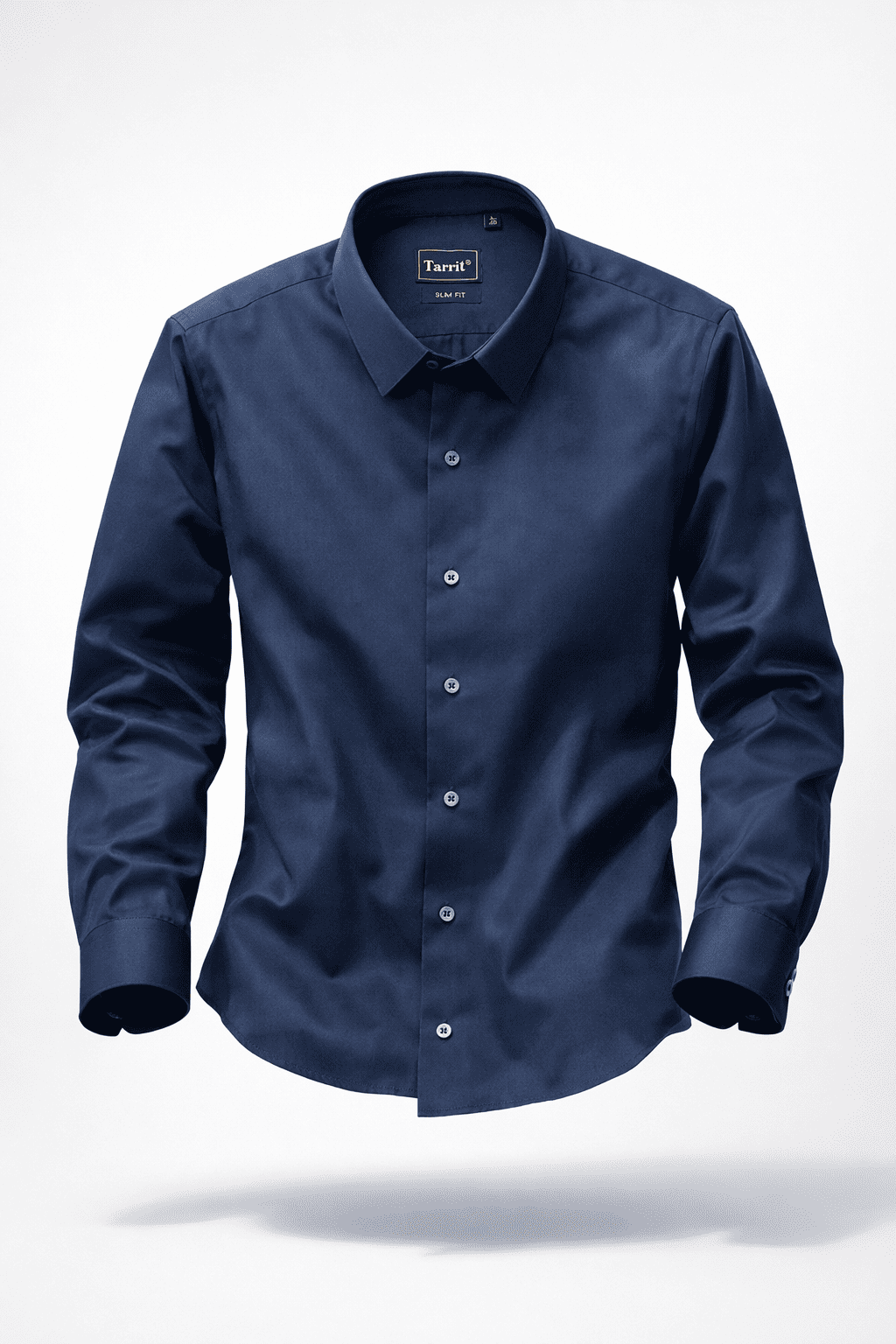
The Complete Wardrobe, Mapped Out
Here's what a finished solid-first wardrobe looks like for most men — a worked example of a best shirt wardrobe structure for men.
| Shirt | Type | Main use |
|---|---|---|
| White (×2) | Solid | Formal, sharpest days, evenings |
| Light blue (×2) | Solid | Everyday office and casual |
| Grey | Solid | Smart-casual, modern edge |
| Navy | Solid | Evenings, meetings, put-together looks |
| Bone | Solid | Warmer alternative to white, layering |
| Burgundy | Solid (accent) | Dinners, occasions, depth |
| Fine stripe | Pattern | Subtle interest, still versatile |
| Check / print | Pattern | Casual days, personality |
That's eight to ten shirts covering formal, smart-casual, relaxed and evening wear — a genuinely complete wardrobe with solids as the load-bearing foundation and patterns as the finish.
Why Building Around Solids Works
- Maximum coordination. A solid foundation means almost any shirt pairs with almost any trouser and shoe.
- Fewer shirts, more outfits. A planned core recombines into far more looks than a random pile.
- Lower cost-per-wear. Foundation solids get worn constantly, so each earns its keep.
- Easy to extend. Adding a pattern to a solid base is simple; there's always something to pair it with.
- Timeless. A neutral solid core doesn't date the way a pattern-heavy wardrobe does.
Common Mistakes When Building a Shirt Wardrobe
- Buying patterns before the foundation. Checks and prints before enough solids leaves a wardrobe that looks full but coordinates poorly.
- Ignoring the ratio. Too many patterns and nothing pairs cleanly; the 80/20 balance exists for a reason.
- Confusing volume with completeness. Twenty random shirts are less complete than ten planned ones.
- Skipping the spare basics. One white and one blue isn't enough when they're your most-worn shirts.
- Underinvesting in the core. The foundation is worn most, so cheap cloth shows fastest exactly where it matters.
People Also Ask
What percentage of shirts should be solid?
Around 80%. For most men, solids should make up roughly four-fifths of a shirt wardrobe, with patterns — stripes, checks and prints — as the remaining 20%. Solids are the versatile foundation you wear daily; patterns are accents for personality and casual days.
Do I need patterned shirts if I have solids?
Not strictly, but a few add welcome variety. A wardrobe of only solids works perfectly well; adding two or three patterned shirts simply prevents it feeling like a uniform. Keep them to a small share so they enhance the foundation rather than compete with it.
How many solid shirts vs patterned shirts should I own?
In a twelve-shirt wardrobe, aim for roughly nine or ten solids and two or three patterned shirts. Build the solid core first — white, light blue, grey, navy, then bone and an accent — and add patterns only once that foundation is in place.
How do I build a capsule shirt wardrobe?
Choose a small, deliberate set where every shirt combines with the rest. Start with versatile neutral solids as the base, keep the total tight, favour quality over quantity, and add a couple of patterns as accents. The goal is complete rotation — every shirt worn, nothing wasted.
What We've Learned Building Wardrobes With Customers
The question we're asked most often isn't about a single shirt — it's "how do I make all of this actually work together?" In our experience, the men whose wardrobes function best are the ones who committed to a solid foundation before buying anything patterned. Customers most often arrive with the reverse problem: a wardrobe heavy on checks and prints they love individually but struggle to pair, and light on the plain shirts that would tie it all together.
We've also found that the 80/20 balance holds up in practice, not just on paper. When a wardrobe drifts much past a fifth patterned, men tell us mornings get harder because fewer things coordinate. A foundation of well-made solids in long-staple Giza cotton — which softens with each wash rather than wearing out — is what keeps the whole wardrobe wearable for years.
Written by the Tarrit styling team.
A Wardrobe in Action Across a Week
Here's how a solid-first wardrobe carries a full week, with patterns appearing only as accents:
- Monday: White solid, charcoal trousers — formal and sharp.
- Tuesday: Light blue solid, stone chinos — easy office day.
- Wednesday: Fine stripe, navy trousers — subtle interest without leaving the comfort zone.
- Thursday: Grey solid, denim, clean sneakers — modern smart-casual.
- Friday: Check or print, chinos — the one pattern-forward, personality day.
- Evening: Navy or burgundy solid, dark trousers — considered and occasion-ready.
Five solids, one pattern, a full week without repetition — the 80/20 framework working exactly as intended.
What Most Men Overlook About Wardrobe Structure
The detail that gets missed is that a wardrobe's completeness comes from how its pieces relate, not how many there are. Two men can own the same number of shirts; the one whose wardrobe is built on a versatile solid foundation will get far more outfits, and far fewer "nothing to wear" mornings, than the one whose shirts were bought at random. Structure is the invisible advantage. And because a solid foundation hides no construction flaws, the fit and fabric of those core shirts do visible work in every outfit they anchor — which is why the foundation is the place to invest, not economise. Build the base well, and everything you add to it looks better by association.
Build Your Foundation With Tarrit
A complete wardrobe starts with a solid core, and that's exactly what Tarrit is built around — versatile neutral solids in Egyptian Giza cotton that form a foundation you'll wear for years. Begin where the wear is heaviest with white and light blue, add grey and navy for range, and reach for a mid-grey like The Founder — Pearl Grey Giza cotton shirt to bridge formal and casual. Explore the full range and lay your foundation from the Tarrit Solids collection, then add stripes, checks or prints as accents once the base is set.
Frequently Asked Questions
How do you build a shirt wardrobe around solids?
Make solids the foundation — roughly 80% of your shirts — starting with white, light blue, grey and navy, then bone and one accent. Add a few stripes, checks or prints as the remaining 20% once the solid base is in place. Build in order of what you wear most.
How many shirts make a complete wardrobe?
For most men, eight to twelve shirts make a complete wardrobe — around nine or ten solids and two or three patterns. Completeness comes from structure and coordination, not sheer numbers, so a well-planned dozen outperforms a crowded, random wardrobe.
Should my first shirts be solid or patterned?
Solid, without question. Solids are the versatile foundation everything else pairs with, so build the core in plain colours first and introduce patterns only once that base can support them. Patterns bought first tend to sit unworn for want of things to match.
Can a wardrobe be all solids?
Yes, and it will function perfectly. An all-solid wardrobe is fully versatile; patterns are optional additions that add variety rather than necessities. If you prefer the clean simplicity of solids only, nothing is missing from a practical standpoint.
What is the ideal solid-to-pattern ratio?
Roughly 80% solids to 20% patterns. This keeps the wardrobe versatile and easy to coordinate while leaving room for personality. Drift much beyond a fifth patterned and fewer shirts pair cleanly, making everyday dressing harder.
Conclusion
Building a complete shirt wardrobe isn't about owning the most shirts — it's about building on the right foundation. Make solids roughly 80% of your wardrobe, start with a versatile core of white, light blue, grey and navy, add bone and an accent, then finish with a few patterns as the 20%. Follow that framework and you get a wardrobe that's smaller, more coordinated and more worn than one built by accumulation — a genuinely complete wardrobe where every shirt has a job. The structure is what makes it work; the quality of the foundation is what makes it last.
Start with the solid core and let everything else build around it. Explore the Tarrit Solids collection to lay a foundation that carries your whole wardrobe.
Last updated: July 2026